
Building a Family After Cancer: Everything You Want to Know about Surrogacy
Written by Melissa Schenkman, MPH, MSJ
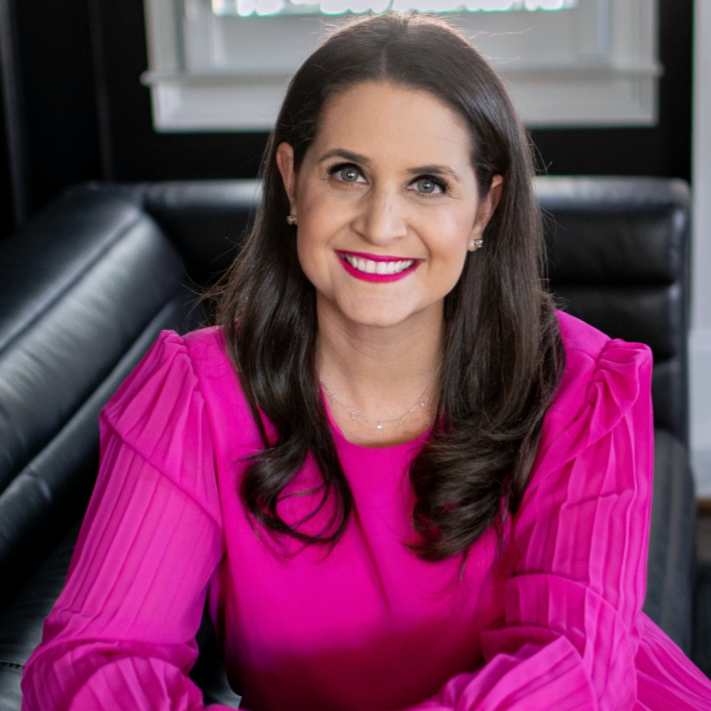
Alexandra French is the co-founder of The Surrogacy Foundation, an Atlanta-based nonprofit with a mission to support people navigating surrogacy journeys and to bring surrogacy into mainstream conversation. After a stage three breast cancer diagnosis at 31, Alexandra and her husband Zach ultimately built their family through surrogacy — and turned that experience into a movement.
Tell us a little about yourself and what led you to surrogacy.
Alexandra French: I'm an Atlanta native, born and raised here. When I was 31, I was diagnosed with Stage 3 breast cancer — no family history and no warning signs. I felt a lump one night and called a doctor the next day. Honestly, I was not expecting it to be anything serious. It ended up being Stage 3, so I went through the whole gamut:
Chemotherapy
A double mastectomy
Radiation
A ten-year hormone blocker protocol
Medically induced menopause
And in the middle of all that, after my double mastectomy, my oncologist found a second type of cancer. That's ultimately what led to me not being able to carry a child, and what propelled us down our own surrogacy journey.
At the time of your diagnosis, had you already been thinking about having more children?
I was very fortunate in that I already had my son, who was almost two at the time, so I'd experienced pregnancy. But we were definitely not done building our family — I always envisioned having more children. I am so beyond grateful to my oncologist because he had the foresight to get me started on creating embryos right away. It wasn't even framed as a choice. I joke that he's the reason my daughter exists. His approach was: Monday, MRI. Tuesday, CAT scan. Thursday, you're meeting with a fertility doctor about retrieving your eggs. It was just scheduled. It was part of my treatment plan.
Do other cancer patients typically always get that kind of guidance from their doctors?
Honestly, I think even when doctors do mention fertility preservation, patients often aren't in a headspace to really hear it. The second someone tells you that you have cancer, you're not thinking about your future family. You're thinking: ‘What do my next three months look like? How do I survive this?’
So information about fertility can go in one ear and out the other. And for some doctors who've been practicing a long time, it may simply not be part of their standard conversation.
What did you know about surrogacy going in?
I'd seen it in movies. I knew one other couple who had just started the process. I remember calling them up and saying, "We have to go through surrogacy — can you please tell me everything?" And that was it. It was more of an acquaintance than a close friend, but I called anyway because I had nowhere else to turn. There wasn't a lot of information out there, and having even one person to talk to made a real difference.
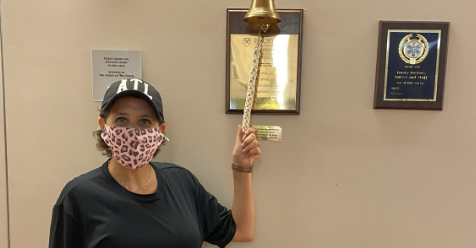
Alexandra ringing the bell after completing her cancer treatment and nearing the start of the search for a surrogate.
What were some of your biggest worries when you first started the process?
There were so many, and they changed at different stages of the journey. Some of the biggest ones:
Will I bond with my child?
I wasn't the one carrying the baby, so would I feel connected right away? I can tell you now: my daughter is my absolute mini-me. She looks like me, she acts like me. You would have no idea she wasn't carried by me.
Will the surrogate take care of herself the way I would?
Is she eating well, exercising, maintaining the kind of lifestyle I'd want for my baby?
What about the social milestones?
Things like whether to have a baby shower felt genuinely complicated. My husband Zach convinced me: you're still the mom. You're celebrating the mom-to-be, not who's carrying the child. Our surrogate came to the shower, and there wasn't a dry eye in the house. It was incredibly special and opened a lot of people's eyes to what surrogacy really looks like.
How does surrogacy work?
I started with a deep dive — researching surrogacy, meeting with that one couple I mentioned, then talking to different agencies. We ended up choosing a local Atlanta agency. I just felt very comfortable with them, like they were going to have our backs the entire time, and they really did guide us throughout.
What a lot of people don't realize is how many people are involved in a surrogacy journey. Beyond the agency and the surrogate or gestational carrier, the full team includes:
Mental health professionals
Separate lawyers for the intended parents and the surrogate
Fertility doctors and reproductive endocrinologists
Hospital staff
Financial professionals
So many people are touching the file at different points. From the time you're matched, it can still take another three to six months before you even get to an embryo transfer.
What were the most emotionally difficult parts of the journey?
The mental health professionals play such a unique role in the process. They're there to evaluate whether everyone is emotionally ready — but so many of the emotions don't surface until you're actually living through it. A lot of it gets written into the legal contracts, so you end up having very intense conversations with your surrogate fairly early. Some of the toughest topics include:
Stances on termination and life-and-death medical decisions
Medication protocols
Who is allowed in the labor and delivery room
What the relationship looks like during the journey — and after
That last one is genuinely hard to know before you've lived it. Do you want to talk once a week for a year? Do you want her at every birthday party? You just don't know until you've started forming this really unique bond. My son was four when our daughter was born, and he now calls our surrogate's children his cousins. He told me, ‘They're more than friends.’ And I was like — you know what? You're completely right.
How did you approach building a relationship with your surrogate?
Our agency gave me great advice from the very beginning: build this relationship on trust, because this person is going to be in your life for a long time — potentially 18 months to two years. It really is like dating. Our relationship progressed in stages.
In the beginning, there were phone and video calls with a lot of small talk — college football, what we were watching on Netflix. Then, we graduated to longer Zoom calls as we got more comfortable. When we met in person, we went for Mexican food with her and her husband, just walked around and got to know each other. Eventually, we introduced our kids to her kids.
It was a whole rhythm of gradually building trust until we both felt ready to say, okay, I'm all in. Let's do this together. Everyone's relationship looks different, though. The most important thing is finding what works for you.
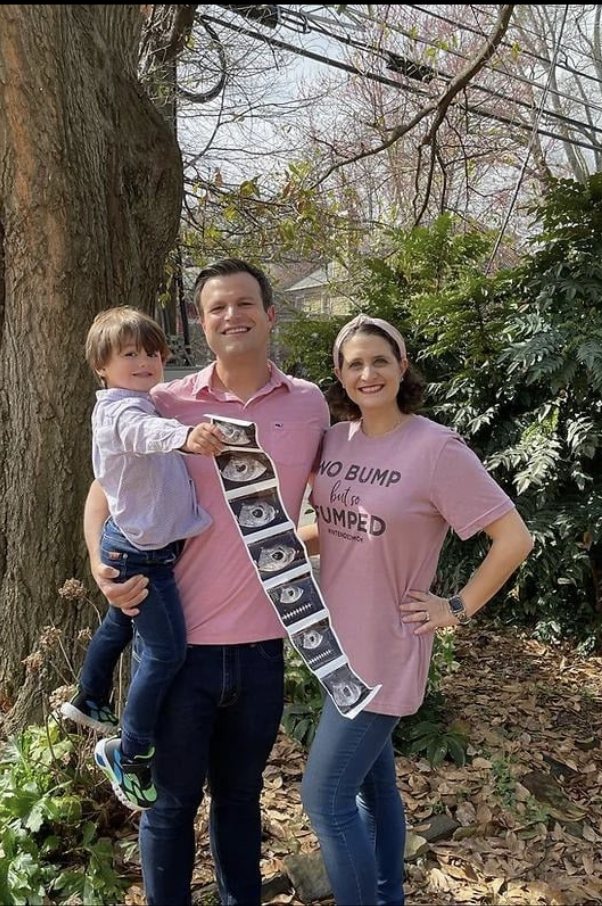
Alexandra, her husband, Zach, and their son sharing the great news that there surrogate (gestational carrier) had their embryo successfully implanted and in nine months their second child would be born.
How did you talk to your friends and family about the decision to pursue surrogacy?
For us, it happened in the middle of my cancer journey, so it was almost just the next item in a very long list of updates. I had a CaringBridge page because there were so many things happening — I was giving people updates on my mastectomy outcomes, waiting on biopsy results, learning about the second cancer — and somewhere in there I said, ‘We've also learned I can't carry another child, so we're exploring surrogacy.’ A few weeks later it was ‘starting radiation next week.’ It was just one more thing in a very full, very hard season.
The bigger challenge was processing the surrogacy journey emotionally while everything else was also changing. The original plan was to finish the hormone blocker, have another child, and then get back on it to complete five years.
That plan completely changed — it went from five years to ten, and I was immediately put into medically induced menopause. It was a lot of gut punches in a row. But through all of it, I kept coming back to being so grateful that my oncologist had the foresight to have me freeze my eggs before any of this became an issue.
What are some of the biggest myths or misconceptions about surrogacy you encountered?
The biggest one, by far, is the assumption that the baby shares genetic material with the surrogate or her partner. I get this all the time. The answer is simply no — it's a gestational surrogacy, meaning the surrogate is carrying the embryo, but the baby is genetically 100% the intended parents'. There is no genetic contribution from the surrogate whatsoever. I like to say she's the oven, not the recipe.
Were there unexpected challenges you'd want others to know about?
Expect the unexpected — that's my biggest piece of advice. A few things we didn't anticipate:
COVID changed everything. We weren't allowed to be in the room for the embryo transfer. We weren't even allowed in the hospital for it. We met our surrogate for lunch afterward.
Timelines shift. A step they say will take six weeks might take twelve. So many people are involved and everything has to clear before you can move forward.
Labor doesn't always go as planned. We thought everything was calm and smooth — we were having breakfast with our surrogate, waiting for our daughter to arrive. My husband had just left to grab lunch when the doctor came in and said we needed an emergency C-section. Our daughter's hand was up above her head. She was born ten minutes later.
As long as you're keeping your eye on the end goal — your child — that's what matters. It is a beautiful, complicated, messy journey. But it is a journey.
Tell us about The Surrogacy Foundation and how it came to be.
I've always been involved in nonprofits, but when I was first diagnosed with cancer, I had about twenty people ask me, "Now that you have cancer, what are you going to do to give back?" I remember thinking — I'm going to survive? That's where my head is right now. But the question stuck with me.
After we learned we'd have to pursue surrogacy, I started looking into what financial resources were actually available for people in this situation. What I found was a significant gap:
Very few organizations focused specifically on surrogacy grants
Those that did often gave amounts like $5,000
Surrogacy can cost upwards of $150,000
Does a $5,000 grant actually help someone, or does it just create more stress because you're holding money you don't know if you'll ever be able to use? I remember sitting on the couch one night and telling my husband, "I figured it out. Once we're through everything, I want us to raise money and give it to someone else for a surrogacy journey." He said, "Sure, fine," and didn't really take it seriously.
Fast forward — when our daughter was about six months old, I told the owner of our agency I was ready to actually raise the money. She said, "Oh, you were serious." I said, "Yes." We eventually established our own 501(c)3, starting as the Gift of Surrogacy Foundation before rebranding to The Surrogacy Foundation. Our signature event is the Surrogacy Soiree — nothing like a traditional sit-down gala, because there is nothing traditional about surrogacy.
That first night, we raised $150,000 — enough to give out our very first grant right then and there.
What has the foundation accomplished since that first night?
We built out our grant process with input from a wide range of experts:
Fertility doctors and reproductive endocrinologists helped develop criteria for medical necessity
Surrogacy lawyers and mental health professionals contributed to the personal evaluation rubric
CPAs and financial professionals shaped the financial component
From all of that came a thorough grant application and review process. We've now given out multiple grants. And just this week, we had our very first baby born from the foundation. That is probably one of the greatest accomplishments of my entire life — to know there is a baby in this world because of an idea I had sitting on my couch. The lives we've changed aren't just the intended parents'. It's their friends, their family, their whole village.
The Surrogacy Foundation has a mission to bring surrogacy into the mainstream.Why does that matter so much to you?
I look at surrogacy the way I look at IVF fifteen years ago. Back then, no one talked about IVF. And now? People post about their transfers on social media. They text their friends "wish me luck" before their retrieval. You could ask almost anyone, and within seconds they could rattle off a handful of people they know who've built their family through IVF. That's where surrogacy needs to go. The more people talk about it, the less stigma there is. And there should be no stigma. There is nothing shameful about surrogacy. It is a beautiful thing that exists for a reason.
What would you say to women who are considering surrogacy or just beginning to explore it?
Everyone's path to surrogacy looks different. People come to it for so many reasons.
For some people, it’s a cancer diagnosis or a hysterectomy that brings them to surrogacy. For others, they are exploring other options for having a child after experiencing recurrent miscarriages. While for same-sex couples who are building their families, surrogacy is a primary avenue to pursue for doing that. And there are so many other reasons in between.
Whatever your reason, embrace it. Know that your path to parenthood is just as meaningful and just as beautiful as anyone else's. It may not be the way you envisioned it happening, but it is incredible.
Because at the end of the day, you look at your child and all you think about is how happy you are. You're not thinking about every step it took to get there. Whether it took one year or six or twelve, that child is there, and it is everything you ever wanted and dreamed about.
Want to hear more from Alexandra? Check out the YMyHealth Podcast on our YouTube channel or on your favorite streaming platform!